
The Three Cantons Unite
William TellThis flow traces how local grievances become a coordinated compact for recovering self-government.
increasing Bearing strength in each event
 decreasing
Bearing strength in each eventdecreasingA League Under Threat

A League Under Threat
The immediate pressure
Werner Stauffacher returns home troubled by Hermann Gessler’s threat against his house and by the governors’ growing interference. Gertrude recognizes that his private anxiety reflects a danger shared across the valleys.
A political awakening
She urges him to consult trusted leaders in the other cantons rather than suffer alone. The crisis begins as an effort to defend old rights, not as a bid for a new sovereign.
That distinction shapes the resistance: the people seek the customary freedom they believe they already possess. Their first step is to discover whether their scattered injuries can be made a common cause.
The Blind Father’s Wrongs

The Blind Father’s Wrongs
A private injury becomes public
Werner Stauffacher tells Walter Furst that Landenberg has ordered Henry of the Halden blinded after his son Arnold fled punishment. The account turns oppressive rule from a political abstraction into an assault on a family.
A wider resolve
Arnold hears that his father has lost his sight and blames himself for the catastrophe. His grief threatens to become solitary vengeance, but the elders redirect it toward collective action.
The revelation gives the planned meeting its urgency. If even an old man can be punished for another’s resistance, no household can assume that its rights are secure.
The Rütli Assembly
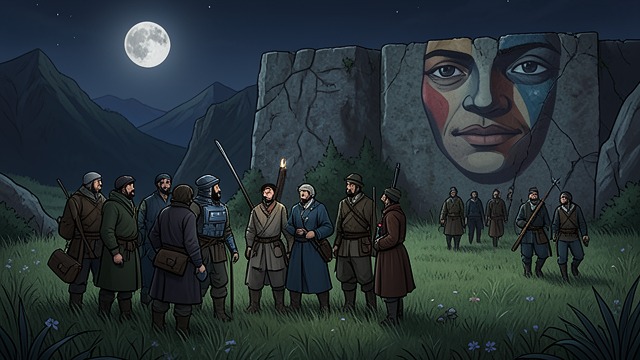
The Rütli Assembly
A gathering in secret
Representatives from the three cantons meet by night at Rütli Meadow, moving cautiously to avoid the governors’ spies. Rosselmann frames their assembly as a legitimate council devoted to the common welfare.
A shared inheritance
Werner Stauffacher recalls a tradition of settlement and self-rule, while the delegates recognize that mountain boundaries do not erase their kinship. They reaffirm that their communities belong to one people and can act together.
The meeting transforms scattered resentment into an organized political identity. Its participants swear mutual support, while carefully presenting their cause as defense of inherited rights rather than ambition.
The Delayed Rising
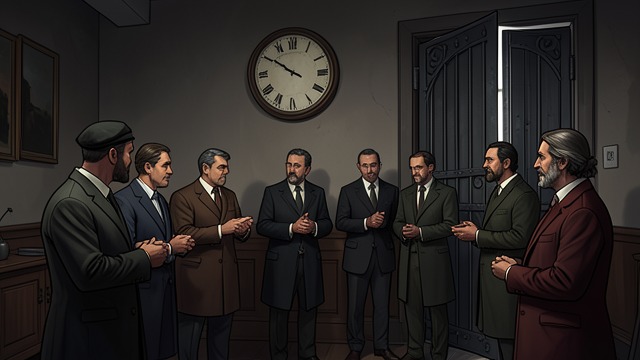
The Delayed Rising
A plan restrained
The delegates debate how to remove the governors and take their strongholds. They choose a coordinated rising on Christmas, hoping to seize the fortresses with minimal bloodshed and then force the officials to leave.
Discipline as strategy
Their timetable is a compromise between urgency and prudence. Some fear that delay gives the enemy time to strengthen its position; others argue that a premature attack could expose the cantons to retaliation.
The oath binds them to patience as well as courage. That restraint later becomes a source of anguish when Tell is seized, forcing the Confederates to reconsider whether circumstances have changed the plan.
The Cantons’ Liberation
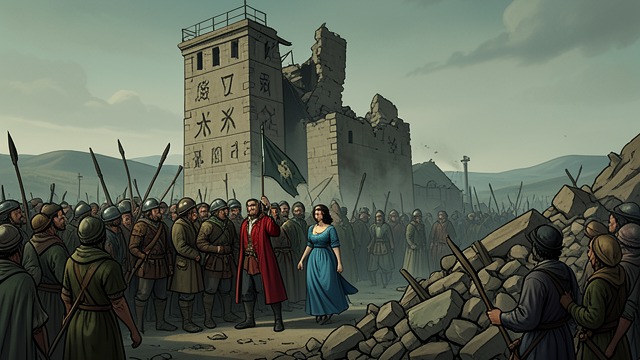
The Cantons’ Liberation
The strongholds fall
The people take the governors’ fortresses, and the resistance spreads through the valleys. The struggle culminates in the removal of foreign officials and the destruction of the structures used to intimidate local communities.
Freedom without triumphal excess
The Confederates celebrate their success but recognize that the work is unfinished. Walter Furst warns that the ruler may seek to restore his authority by force, so the victors must remain united.
The ending presents liberation as the recovery and protection of communal self-government. Bertha’s admission into the league and Rudenz’s freeing of his serfs give that freedom a future beyond the immediate defeat of the governors.
Early in the story, at Steinen
Early in the story, at Walter Furst’s house
At night, midway through the story
At the end of the Rütli meeting
Near the ending, as the planned rising succeeds
